Ferdinand Alvarez de Toledo Memorial Medal

Ferdinand Alvarez de Toledo Memorial Medal
Fernando Á lvarez de Toledo, the third Duke of Alvarez. The commemorative medal features a bust of the Duke in armor, made in 1567 to commemorate his tenure as governor of the Netherlands in 1557. Duke Ferdinand Alvar (1507-1582) was a Spanish nobleman, general, and politician. During the Eighty Years' War, he suppressed a rebellion against Spanish rule in the Netherlands. He served as the Governor General of Spain and the Netherlands from 1567 to 1573.
Commemorative medal for the 600th anniversary of the founding of the city of K ö rnberg during the Austrian Empire in the 19th century

Commemorative medal for the 600th anniversary of the founding of the city of K ö rnberg during the Austrian Empire in the 19th century

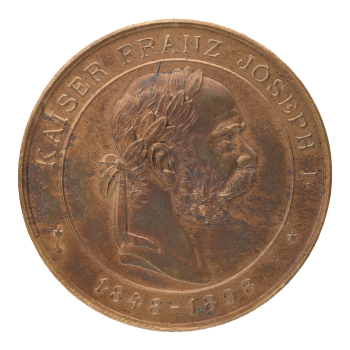
It was cast to celebrate the 600th anniversary of the founding of the city of K ö rnberg in Austria and the 50th anniversary of the reign of Franz Joseph I. The portrait on this commemorative coin is of Franz Joseph I on the side, with the inscription "EMPEROR FRANZ JOSEPH I. 1848-1898". The back of the commemorative coin displays the emblem of the city of K ö rnberg, with the inscription "MUNICIPALITY OF KORNEUBURG 1298-1898". This commemorative coin is made of bronze, with a diameter of 5 centimeters, and was minted in 1898.
The Michael Haydn Medal, a commemorative medal from the Austrian Republic in the 20th century

The Michael Haydn Medal, a commemorative medal from the Austrian Republic in the 20th century
Michael Haydn was an Austrian composer of the modern era, and this commemorative medal was made in honor of Michael Haydn. The front of the commemorative medal features a half profile portrait of Haydn, with the words' MiCHAEL HAYDN: 1737-1806 'written on it. On the back of the commemorative medal is a scene of Hohenzollerbach, with two little angels on the left holding violins and a sheet music on the right. The commemorative medal is made of bronze with a diameter of 7.6 centimeters. It was made in 1927 and is exhibited at the State Museum of Lower Austria in Austria.
Commemorative medal of the Austrian Republic period in the 20th century, "Outstanding Medal of the Lower Austrian Agricultural Chamber of Commerce"

Commemorative medal of the Austrian Republic period in the 20th century, "Outstanding Medal of the Lower Austrian Agricultural Chamber of Commerce"

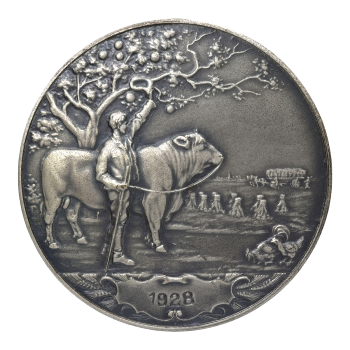
This commemorative medal is made to celebrate the outstanding performance of the Austrian Agricultural Chamber of Commerce. The front of the commemorative medal features a farmer and his cattle in front of an apple tree, with a harvest scene in the background. The back of the commemorative medal features the emblem of Lower Austria and five castles, while the front displays laurel leaves. It says' Progress. Lower Austrian Agricultural Chamber of Commerce. '. The commemorative medal is made of bronze, with a silver plated surface and a diameter of 5.5 centimeters. It was made in 1928. This commemorative medal is on display at the State Museum of Lower Austria in Austria.
The commemorative medal of the Austrian Empire period in the 19th century, titled "Rudolf Crown Prince Tasting Reiz Gold Wine Commemorative Medal"

The commemorative medal of the Austrian Empire period in the 19th century, titled "Rudolf Crown Prince Tasting Reiz Gold Wine Commemorative Medal"

The front of the commemorative medal features a quarter profile portrait of Rudolf, with the words' ARCHDUKE RUDOLF CROWN PRINCE OF AUSTRA 'written on it. The back of the commemorative medal features a view of a tall cup with a lid and the city emblem of Leitz. The creator of the commemorative medal is Kristelbauer. The medal is made of bronze with a diameter of 5.4 centimeters and was made in 1888. It is collected in the State Museum of Lower Austria, Austria.
Bronze Commemorative Medal of the Habsburg Dynasty: Commemorative Medal for 600 Years of Habsburg Family Rule

Bronze Commemorative Medal of the Habsburg Dynasty: Commemorative Medal for 600 Years of Habsburg Family Rule

This commemorative medal is to celebrate the 600 year reign of the Habsburg family. The front of the commemorative medal features Rudolf I sitting, holding a scepter and the flag of the Austrian Duchy with five eagles. After the Habsburg family entered Austria in the late 13th century, their power gradually increased and they established a wide empire based in Austria. Rudolf I was the lord of southern Alsace and northern Switzerland. With the help of secular and ecclesiastical princes, Rudolf I successfully launched several campaigns against his main competitor, the most powerful German vassal, King Ottokar II of Bohemia, and ultimately achieved his goal in one battle.
Austrian Entrepreneur Commemorative Medal "Faber's New Year Commemorative Medal"

Austrian Entrepreneur Commemorative Medal "Faber's New Year Commemorative Medal"

This commemorative medal was made to celebrate the New Year of 1907 by the brewery owner Moritz Faber, his son Carl, and grandson Theodore. The front bust of the commemorative medal features Moritz, Carl, and Theodore, as well as the coat of arms of the Fir Branch and the Brewers Guild. Moritz Faber was born on March 14, 1837, Karl Faber was born on August 30, 1866, and Theodore Faber was born on February 1, 1897. The commemorative medal is made of copper, measuring 9.9 x 6 cm, and was made in 1906. The commemorative medal is now located at the State Museum in Lower Austria, Austria.
The commemorative medal of the Austrian Empire, "Franz Joseph I Commemorative Medal at the Age of 80"

The commemorative medal of the Austrian Empire, "Franz Joseph I Commemorative Medal at the Age of 80"

The Emperor Franz Joseph I 80th Birthday Commemorative Medal was issued by Emperor Franz Joseph I of Austria in 1910. The obverse of this medal depicts a side portrait of the emperor, while the reverse displays the architecture of the Franz Joseph I Emperor Museum located in Baden near Vienna. Franz Joseph I was the Emperor of Austria, who ascended to the throne on December 2, 1848 and remained there until his death in 1916. During his reign, his territories and territories were known as the Austrian Empire, but were reorganized as the Austro Hungarian Empire in 1867. The British Museum, currently located in London.